

Speaker,Instructor,Author
“I help educators understand and implement AI in teaching & learning—in ways teachers actually use—via presentations and workshops (in English/Spanish/French).”
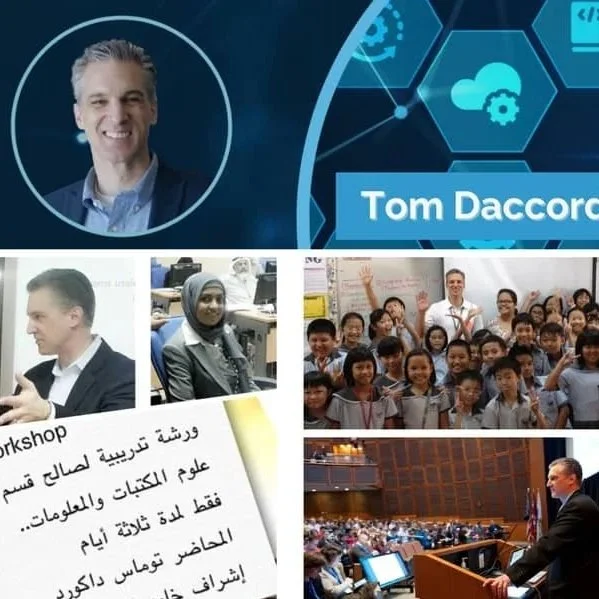
Tom Daccord
Career In Brief:
15-year international teacher (U.S./Canada/France/Switzerland)
Designated “Outstanding Educator” by Singapore Ministry of Education
Co-founder and former CEO of EdTechTeacher
Author of 4 books on education technology
Trilingual presenter: English, Spanish, French
Keynote Speaker in over 10 countries
TOM HAS PRESENTED AT THESE CONFERENCES AND INSTITUTIONS


Popular Sessions

Show Your Thinking: Multimodal Explanations With AI

AI for Language Learning: Conversation, Feedback, and Cultural Nuance

AI Formative Assessment & Feedback at Scale

Differentiation With AI: Same Goal, New Tools

Modelos Innovadores de
Aprendizaje con la
IA

Using AI to Improve Student Writing Without Replacing It
TOM’S TAKES: RECENT VIDEOS
TOM’S TAKES: RECENT POSTS
Douglas Kiang Is Teaching for the AI World His Students Already Live In
Back from summer travel, I’ve just posted about a fascinating interview with Douglas Kiang, a “radical” classroom AI-implementer. An experienced English teacher, computer science teacher, and AI literacy leader, Douglas willingly helps students defeat the very systems designed to preserve academic integrity. His teaching strategies amay seem radical, but his ideas are harder to dismiss.
AI in Math: Does the Tool Position Students as Mathematical Thinkers?
Karen Levin, founder of Math for Humans, helps educators think about math teaching in an age of AI.
For her, the issue of cheating with AI is not simply whether students can get an answer from AI. The deeper question is this:
How does the tool position students as mathematical thinkers?
AI Can Finally See the Student, Not Just the Answer.
An AI “Interaction Model” is a step beyond the awkward “turn-based” exchanges that still define most AI use — user starts, AI waits, AI responds, user responds — and represents something much more fluid.
So, what happens when the AI can recognize hesitation, self-correction, confusion, or partial understanding?

AI Tools & Uses: A Practical Guide for Teachers
If you're willing to learn and join the vanguard of educators shaping the future of education, then this book is for you. AI Tools & Uses: A Practical Guide for Teachers will be your roadmap, providing practical strategies, constructive examples, case studies, and step-by-step guidance to help you harness the power of AI in your classroom.
TALK WITH TOM